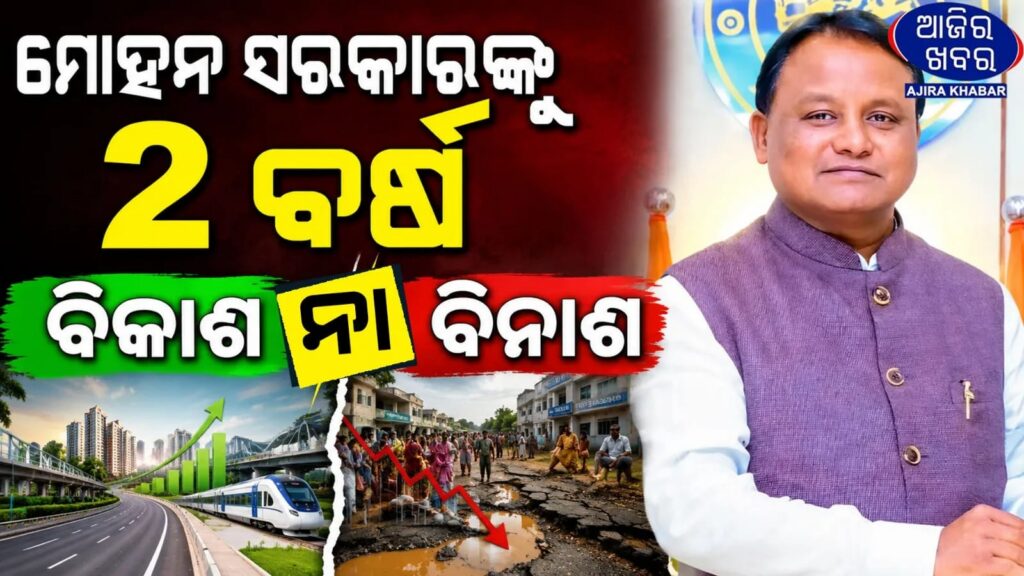
Two Years of Mohan Majhi Government: Development or Disappointment? Odisha Debates the Report Card
A New Political Era in Odisha
June 2026 marks two years since the Bharatiya Janata Party (BJP), under the leadership of Chief Minister Mohan Charan Majhi, assumed power in Odisha, ending the Biju Janata Dal’s uninterrupted 24-year rule. The change was historic, raising hopes for a new style of governance, fresh policies, and accelerated development.
As the government completes two years in office, the debate across Odisha has intensified. Supporters highlight welfare initiatives, investment commitments, and cultural revival, while critics point to concerns over law and order, unemployment, and unfulfilled promises.
So, has the Mohan Majhi government delivered on its promises, or has it fallen short of public expectations? The answer lies somewhere between achievement and challenge.
The Government’s Major Achievements
Subhadra Yojana: A Landmark Welfare Initiative
One of the most talked-about initiatives of the Majhi government has been the Subhadra Yojana. Designed to empower women financially, the scheme has brought direct financial assistance to millions of beneficiaries across the state.
The government claims that the initiative has strengthened women’s participation in economic activities while supporting self-reliance and financial inclusion. The ambition to create more “Lakhpati Didis” has become one of the administration’s flagship goals.
Relief for Farmers
Agriculture remains the backbone of Odisha’s economy, and the government’s decision to increase paddy procurement prices has been welcomed by many farmers.
The enhanced support price has provided direct benefits to lakhs of farming families, helping improve rural incomes and fulfilling one of the BJP’s key electoral commitments.
Focus on Odia Identity and Culture
The reopening of the Ratna Bhandar of Lord Jagannath Temple and the government’s emphasis on preserving Odia language, culture, and heritage have generated considerable public interest.
For many citizens, these steps symbolize the government’s commitment to protecting Odisha’s cultural identity while strengthening regional pride.
Attracting Investments
The state has witnessed significant investment proposals over the last two years, with the government aggressively promoting Odisha as a preferred destination for industries.
Officials argue that these investments have the potential to create employment opportunities, improve infrastructure, and boost long-term economic growth.
Challenges and Criticism
Despite these achievements, the government has faced serious criticism on several fronts.
Concerns Over Law and Order
Law and order has emerged as one of the most debated issues during the government’s tenure.
Several high-profile incidents have raised questions about public safety and policing. Opposition parties have repeatedly accused the administration of failing to maintain effective law enforcement, while the government insists that necessary corrective measures are being taken.
Employment and Unfulfilled Expectations
Job creation remains one of the biggest challenges facing the state.
Many young people continue to seek stable employment opportunities, and critics argue that election promises regarding government recruitment have not been fully realized. While investment announcements have generated optimism, concerns remain about whether these projects will translate into meaningful local employment.
Political Debate Over Welfare Programs
The opposition has also accused the government of rebranding several existing welfare schemes rather than introducing entirely new initiatives.
Supporters reject this criticism, arguing that improving and expanding welfare delivery is more important than changing policy names. Nevertheless, the issue continues to fuel political debate.
Inflation and Cost of Living
Like many states across India, Odisha has also faced concerns related to rising prices of essential commodities. The increasing cost of household necessities has affected common citizens, leading to criticism regarding market regulation and price control measures.
The Road Ahead
Political observers note that the first two years of any government are often spent understanding administrative systems, implementing priorities, and establishing governance frameworks.
Chief Minister Mohan Majhi has recently reviewed the performance of various departments and ministers, signaling an effort to address shortcomings and improve delivery mechanisms. The government’s next three years will likely determine whether it can convert its early promises into long-term achievements.
Development or Disappointment?
The answer depends largely on whom you ask.
Supporters see a government focused on welfare, agriculture, cultural pride, and investment-driven growth. Critics point to governance challenges, law-and-order concerns, unemployment, and unmet expectations.
What is undeniable, however, is that the first two years of the Mohan Majhi government have been politically significant and closely watched by the people of Odisha.
As the state moves forward, the ultimate verdict will not come from political parties or analysts but from the voters themselves. The next election will determine whether Odisha’s citizens view these two years as a period of meaningful transformation or a missed opportunity.
For now, the debate continues—and the real test for the Mohan Majhi government may still lie ahead.