Mamata Banerjee Faces EC Setback: Revisiting Indira Gandhi’s 1969 Political Crisis
New Delhi/Kolkata: The Election Commission’s recent decision involving the Trinamool Congress has brought the party’s internal dispute and electoral identity into sharp focus. On September 17, the Election Commission temporarily froze the All India Trinamool Congress name and its traditional “Flowers and Grass” symbol for the upcoming by-elections, directing the rival factions to choose separate names and symbols.
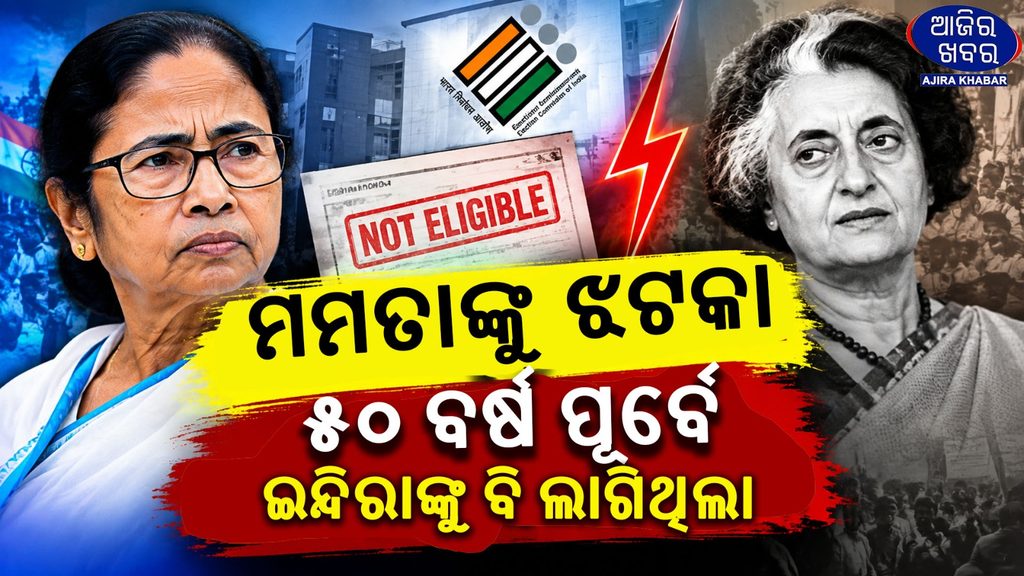
The development has also prompted comparisons with an earlier episode in Indian political history involving former Prime Minister Indira Gandhi, whose conflict with senior Congress leaders eventually resulted in the historic Congress split of 1969.
What Happened to the TMC Name and Symbol?
The Election Commission said there were two rival groups within the Trinamool Congress, one led by Mamata Banerjee and another led by the rival faction. The Commission directed both groups to submit choices for temporary names and symbols for the upcoming by-elections.
On September 18, the poll panel subsequently allotted separate identities to the two factions. The Mamata Banerjee-led faction was allotted the name “Mamata All India Trinamool Congress” along with the Football Player symbol, while the rival faction was allotted “Democratic Trinamool Congress” and the Envelope symbol.
The arrangements are applicable to the upcoming by-elections, while the broader dispute over the party’s original name and symbol remains a matter of political and legal significance.
The 1969 Congress Crisis
Nearly six decades earlier, Indira Gandhi faced a major confrontation within the Congress. After becoming Prime Minister in 1966, she increasingly came into conflict with the party’s established leadership, often referred to as the Congress Syndicate.
The confrontation became particularly visible during the 1969 Presidential election. The Congress organisation backed Neelam Sanjiva Reddy, while Indira Gandhi supported Vice President V. V. Giri, who contested as an independent candidate.
Giri eventually defeated Reddy. The result intensified the differences between Indira Gandhi and the Congress leadership. According to historical accounts, Indira Gandhi was expelled from the party in November 1969, after which Congress formally split into two factions: Congress (Organisation) and Indira Gandhi’s Congress (Requisitionists).
From Party Split to the 1971 Election
The 1969 split did not end Indira Gandhi’s political career. Instead, the dispute led to a major political contest in the 1971 Lok Sabha election.
Indira Gandhi campaigned under the slogan “Garibi Hatao” and sought a direct mandate for her political and economic programme. The Election Commission’s historical data records that Congress (R) won 352 of the 518 Lok Sabha seats in the 1971 election.
The NCERT-based SATHEE resource records that Indira Gandhi’s Congress (R) secured about 44% of the vote and 352 seats, while Congress (O) won only 16 seats.
The result significantly strengthened Indira Gandhi’s position in national politics and changed the balance of power within the Congress movement.
Two Different Political Episodes
The present TMC dispute and the 1969 Congress crisis are separated by decades and occurred under very different political circumstances. The Election Commission’s current action concerns the use of a party name and electoral symbol amid an internal dispute, whereas the 1969 Congress crisis involved a much broader organisational and ideological conflict within India’s then-dominant national party.
Still, both episodes illustrate how disputes within major political parties can lead to questions over organisational control, party identity and electoral symbols.
What Happens Next?
The TMC dispute is now being closely watched ahead of the upcoming by-elections. The Election Commission has provided separate identities to the rival factions for the polls, while the political and legal contest surrounding the party’s original identity continues.
The comparison with the 1969 Congress split therefore provides historical context, but the eventual political consequences of the present TMC dispute will depend on subsequent organisational, electoral and legal developments.
Disclaimer: This article presents documented political developments and historical context. References to political claims or comparisons are attributed to the relevant sources and should not be interpreted as an endorsement of any political party or leader.